Sunday, December 21, 2014

Fuji X100T: Curse of the Built-in Flash

Fuji X100T without the kitchen sink.

Fuji is great, don't get me wrong. It's just that the X100 would look better without a built-in flash (or audio ports for video, which is lousy quality anyway). This goes especially for the black version where the flash really sticks out like a sore thumb. You could say I'm an available light purist. You could also say I wish Fuji would make a compact flash unit with a tilting and swiveling head to allow for bounce flash.

Friday, August 29, 2014

Out-of-print Photobooks That Should Be Reprinted

I will add to this list as they occur to me.

In Flagrante by Chris Killip.

A1: The Great North Road by Paul Graham.

A Way of Seeing by Helen Levitt.

Brooklyn Gang by Bruce Davidson. 

Streetwork by Philip-Lorca diCorcia.

Thursday, August 28, 2014

Photokina 2014: What They Should Make!

Because I'm better at running their companies than they are. Obviously.

Leica
Put a rangefinder-style EVF and some real controls on the Leica T.

I should also note that a really big screw cap replaced the loathsome red dot on the new M-P Type 240. There are five spots on the front of the camera. Five. Let that sink in. Now ask yourself: Why is Leica making their flagship product uglier?

Fuji
If the features added to the X30 suggest what features the X100T and X-Pro2 will have, you’ll get no complaints from me. The only thing I don’t like about the X30 is the 2/3'' sensor. I’ll take a larger sensor and lens, please.

Sony
The RX100 Mark III was a letdown for me. I don’t want a pop-up EVF and a 24-70mm-e f1.8-2.8 lens. I want a regular built-in EVF and a 24-100mm f1.8-2.8 lens. Basically, I want a 1'' sensor camera that is coat pocketable, not pant or shirt pocketable. I want something that I can take pictures with in the sun and has decent dynamic range, because my other digital camera is an iPhone.

Panasonic
The LX100 and GM5 rumors sound promising. I hope the LX100 has a 12-50mm f/2.8-4 lens and a rangefinder-style EVF.

Olympus
Still no rangefinder-style mirrorless with a built-in EVF. Meh. I wouldn’t mind a 12mm f/4 tilt-shift lens.

Ricoh
Well, the GXR system is dead. They should put an EVF in the GR, though.

Nikon
V4 with a rangefinder-style EVF. The Internet would love it. Come on, Nikon. You’ve tried the rest, now try the best (form factor).

Canon
Eh, whatever. When are those image stabilized 50/1.4 and 85/1.8 primes coming?

Samsung
They make cameras?

Thursday, June 19, 2014

Thoughts While Buying Photobooks


A blessing and a curse: The Photobook: A History, volumes 1-3,
by Martin Parr and Gerry Badger.
 
“I haven’t actually seen it, but Mike Johnston / Jörg Colberg / Jeffrey Ladd recommended it, so it must be good.”

“Why doesn’t Arcana / Hennessey + Ingalls / Opening Ceremony have that book? It was on photo-eye’s ‘Best Books of the Year’ list!”

“I wonder if people will stare at me if I look at this book of nudes.”

“If I ask (famous photographer) to just sign his/her name in my book, will s/he hate me forever?”

“I’ve been waiting years for them to reprint (classic out-of-print photobook), so of course I have to buy it.”

“If I don’t buy it now, the price will skyrocket in a few months, and I’ll never be able to get a copy for a reasonable price.”

Postalco No. 90060 Camera Case


Postalco No. 90060

Postalco made this case for the Ricoh GRD, but its style (even in black or red leather) doesn’t really match. It’s too nice for something so utilitarian. A Contax T3 or Fuji Klasse would look the part, though.


$336 (Cooper Hewitt Shop) or $392 (Creatures of Comfort).

Tuesday, June 17, 2014

Canon DSLR Morphology: The Prism

Like a person’s nose, the viewfinder prism is the central integrating part of an SLR’s design, and consequently it is the most distinguishing visual trait. Ideally, it articulates the essence of the forms around it. Unfortunately, the prism is often the subject of “creative expression” for marketing purposes. To encourage the acceptance of planned obsolescence, they must approach the prism as an area for decoration of dubious quality. Just looking at the example of Canon, it’s easy to see that this phenomenon generally has a direct relationship with the camera’s price: as the cost goes down, so does the quality of the prism’s design.
The Canon 1Ds Mark II (4/04) and III (11/07).

The current stylistic trend in camera design has been toward linearity and simpler geometry, a shift embodied most subtly in Canon’s 1-series. The blobby, NURBS-enabled design of the original 1D (December 2001) through the 1D MkIIn (October 2005), whose prism always reminded me of an elephant’s forehead, was supplanted by the slightly less blobby design introduced by the 1D MkIII (May 2007). Apart from it’s pronounced sloping shoulders, the key differences are the two edges that run down the face of the prism, formed by a curved plane and saddle surfaces which intersect. The concave shoulders sweep down from the flattened, convex band of the prism’s center. Personally speaking, this post-2007 prism is one of the classic SLR prism designs along with the Nikon F’s eye level finder, Pentax Spotmatic, Topcon RE, Contax RTS, and Leica S2.

Elephant's forehead.

Some kind of frog or toad.

In these three-quarter views, note how the rounded edge on the right side of the MkIII has a smaller radius and creates a more distinct line.

Canon 1Ds MkII (November 2004).

Canon 1Ds MkIII (November 2007).

The trend toward linearity can also be seen in the 5D series. It’s a shame that Canon hasn’t produced a version of the 1-series without the vertical grip since the design, interface, autofocus, and weather sealing are not quite as nice in their other cameras.

Canon 5D (October 2005).

Canon 5D MkII (November 2008).

Canon 5D MkIII (March 2012).

Rather than settling on a strong design for several generations, each iteration of the 5D series has shifted from one uninspired, noncommittal design to another, just like the x0D series. The original 5D’s prism oddly resembles a pig’s nose, while the MkII needlessly departs from the 1Ds MkIII’s basic design by adding chamfered edges (a bit like the Pentax 645D) and an angular throat. In trying to slim down the body, the buttons in front of the top LCD jut out from the edge a little bit, which clutters up the design. The exaggeratedly chamfered edges on the MkIII make the prism look fairly rounded from the front, which has really only worked on the Leica S2 and Sony A99 because they both have raised shoulders that minimize the viewfinder’s protrusion.

Prism of the Canon 5D MkIII.

That said, the Canon 6D deserves mentioning for its admirably plain design.

Canon 6D (November 2012).

The design of the x0D series has been the most erratic, leading to an occasional hit but mostly misses. The 10D should remind you of the Nikon D4 and D800, Sony A100, Panasonic G and GH series, and Samsung Galaxy NX (along with a handful of bridge cameras) since the motif of a single contoured surface that blends the front of the top plate with the front of the prism was, I think, introduced by this camera. I would have to dig further to be sure. My favorite is the straightforward 30D. It’s the Platonic ideal of an APS-C DSLR. The 7D would look better if it didn’t seem overinflated, and I’m not sure what happened with the 40D and 50D. They tried to add a touch of hardness to it, but chiseling some facets on the prism’s beak did not work out in this case.

Canon 10D (March 2003).

Canon 20D/a (September 2004/February 2005).

Canon 30D (March 2006).

Canon 40D/50D (September 2007/September 2008).

Canon 7D (October 2009).

Given the higher specifications and stronger designs of higher end cameras in general, it is tempting to look at new upgrades in a lower end series and see a connection between internal improvements and the quality of external design. Of course, no such correlation exists within a series, only between them. A better looking design is a matter of chance when it comes to mass market consumer cameras. It is only at the high end and in niches where standards of good design are maintained. An obnoxious fact of modern life.

Saturday, April 26, 2014

The Leica T Ad: That's a Lot of Sandpaper


The Most Boring Ad Ever Made? from Leica Camera on Vimeo.

The appeal of this ad lies either in the reality or the perception that few people these days exercise that kind of meticulous attention.

Extra points if you can count how many sheets of sandpaper he uses.

Wednesday, July 3, 2013

Practical Gifts for Photographers

There are lots of nifty photography related gifts out there, ranging from lens coffee mugs, Photoshop refrigerator magnets, camera cookie cutters, wacky miniature tripods, and tiny DSLR-shaped flash drives. Other people have compiled lists of these items already, so here are some practical tools and materials instead. They are categorized by general purposes as well as by digital and film photography. Some items for the darkroom are discontinued, so this list is being uploaded early enough to wait for them to go up for sale.

Friday, December 21, 2012

Leica M-E: Almost for Me


Leica M-E

While Leica added significant new features to the Leica M Type 240 and S Type 006, they removed two features from the M-E: the USB port and frameline preview lever. Both of them were extraneous and detracted from the camera's simplicity, and their removal suggests a reaffirmation of minimalism to counterbalance the complexity of the M and S. These changes lower the camera's cost a little, but the real upshot is a better looking camera. The M-E also has the new leatherette covering that is less shiny and doesn't remind me of cottage cheese.

Someone must have used the USB port, right?

On the other hand, I'm frustrated by the new grey paint finish, the absence of the top plate engraving, and the inclusion of the red dot. We've gone through this ugly/pretty cycle twice already with the M8 -> M8.2 and M9 -> M9-P. The Leica M9-P's top plate is as definitive as a digital M can get, so I would have preferred it if they had stuck with that one. It's nice when digital cameras, especially Leicas, don't exhibit traits of planned obsolescence, i.e., when they're clearly made to last. No doubt there will be an M-E.2 in about a year and a half, and it could be the most beautiful digital M ever.

Imagine the M-E with the M9-P's top and bottom plates.

Thursday, October 25, 2012

Style by association


An unlikely scenario?

As an overly concerned camera style geek, I think this photo from Nikon’s V2 webpage is ridiculous. iPhones, street cafes, and bretons are technically cool, but a young stylish guy is not the kind of person who would want to bother with Wi-Fi adapters and homely cameras. Well, not in my imagination, anyway. If you want your products to appeal to stylish people, your products should be stylish. You can’t set up a photoshoot to make something look cool and expect it to be convincing.

Tuesday, October 23, 2012

Nikon V2: One step forward, two steps back


The ugliest camera since the Pentax K-01?

Nikon Rumors now has the full story on the V2. What can I say other than it’s truly ugly? On the bright side, the controls are now much improved and a 32/1.2 is on the way. The angle of view and dept-of-field are equivalent to an 85/3.2 in 135, except the lens speed is, uh, f/1.2. Not too shabby. The press release unfortunately doesn’t say when the lens will be released or what it will cost.

Spiffy.

Friday, August 24, 2012

The Hypothetical Camera Comparison Chart


Click image to view original size.

What's Photokina without getting your hopes up, checking DC Watch Impress every five minutes, and feeling disappointed when it's over? I always write a list describing what I wish (reasonably or not) the camera companies would make or change on their current models, but this year I also did a pairwise comparison chart to rank them in order of my preference. There are 11 cameras total; at the last minute, I removed the upcoming Fuji X-mount camera(s) because one was just leaked.


The Results

1. Leica Mirrorless
Score: 10

Of course the one with the least information to work with gets first place. All we know is that it will have an APS-C sensor or larger, that Leica acknowledges the improvements in EVFs, and that they are impressed with the hybrid viewfinder from Fujifilm. Unfortunately, it may not be announced at Photokina as they had expected a year ago. I picture it being like the X100, only better.

- Galilean viewfinder with LCD projected framelines.
- Same controls and menus as the Leica S2 (shutter speed dial, small OLED display on top, rear thumb dial, no aperture ring on the lens, four buttons around the LCD).
- Fixed 35mm-e f/2 lens.
- Optical image stabilization.
- Ricoh-style snap mode that can cycle through a custom memory bank of standard focus distances.
- Fast autofocus down to EV1-3.
- PDAF on the sensor.
- Ultrasonic motor.
- No built-in flash or AF assist lamp.
- Standard hot shoe.
- Weather sealing.
- Modern, authoritative design.
- $3000-3500 is fine.

2. Fujifilm X200
Score: 9

I'm not expecting any big changes, which sucks. The X100 is around the bottom of my list, even though it has that all important Galilean viewfinder and lens spec. I'd happily buy my imaginary replacement model.

- Fast AF in low light.
- PDAF on the sensor.
- Cleaner, less disorderly design.
- Focus mode switch from the X-Pro1.
- Recessed exposure compensation dial.
- 1/3 stops on aperture ring.
- Standard filter ring and bayonet-mount for hood.
- No built-in flash or AF assist lamp.
- No video mode or microphone ports.
- 'Q' button.
- Four-way controller from X-Pro1.
- Better battery life and charger.

3. Pentax Mirrorless
Score: 8

As you'd expect, the more imaginary cameras outrank the cameras with a basis in reality. Among the mirrorless cameras with an EVF, the key feature is built-in image stabilization (or image stabilized primes). While Sony's Alpha system has Super SteadyShot, they decided not to use it for NEX to keep the bodies as small as possible, a lousy tradeoff if you asked me. By contrast, the Pentax K-01 still has Shake Reduction. After the Ricoh acquisition, it's unlikely that there will be a new mirrorless system from Pentax, but this is what I'd like to see if they gave it another try.

- Short flange back distance.
- Shake Reduction.
- APS-C sensor with PDAF.
- A good EVF.
- Tablet-shaped body, e.g. Leica M, Nikon J1, Canon EOS M. Not with protruding mounts and grips like Sony NEX or faux-prisms like the Olympus OM-D and Nikon V1.
- K-5 level controls: top LED panel, two dials, etc.
- Weather sealing.

4.  Olympus Pen Pro
Score: 7

This is one notch below the Pentax because of the sensor's aspect ratio. I couldn't care less about the consequences of its slightly smaller size and one stop reduction in "depth-of-field control." It's just that for street photography, travel, and casual picture taking (the reasons I want a digital camera at all), I prefer the 3:2 aspect ratio. Portraiture is another matter. It's too bad that full frame cameras are 3:2, and that those Super Four Thirds rumors are probably hogwash, because I want as big a sensor as possible for portraits, and I want it to be 4:3. I'd get a MFDB if I could.

Also, and I know it's stupid, but I don't like the OM-D even though it has nearly everything I want. Putting aside my preference for Galilean viewfinders, what the OM-D lacks is a rangefinder-based design. Pseudo-DSLRs are the complete opposite of what I want. If you look at a rear view of the OM-D, you can see the extra height added because of the clunky faux-prism. It would have been cooler if it was more like the Sony NEX-7 and Fuji X-E1, and the LCD would have stayed nice and clean instead of getting greasy from your nose touching it all the time. Left-eye dominant people will understandably prefer the central EVF position, but not me.

- EVF in the corner like a rangefinder.
- PDAF on the sensor.
- Design style like the E-1, a modern classic.

5. Ricoh GXR MkII
Score: 6

It's been three years since the GXR was announced, so a MkII is probably on its way. The one thing I would add is an EVF in the corner. What else is there to do? Not much, because Ricoh knows what they're doing. More lensors would be nice, too.

- EVF in the corner of the body unit.
- 35mm-e f/2, 50mm-e f/1.4, and 75mm-e f/2 lens units with 16mp APS-C sensors.
- PDAF on the sensor.

6. Sony NEX-7n
Score: 5

The imaginary version of one of the hottest cameras of the last year should be higher up on my list, shouldn't it? In the realm of the actual, the NEX-7 is near the top of my list, but small things that I don't expect to change prevent it from maintaining its position in my alternate universe. Tri-Navi? Pretty cool, but I don't like that there are no detents on the dials and that the settings are only visible on screens, nothing external and physical. An LED panel would change my mind, and I've yet to test White Magic in the sun, which is more likely. IBIS? Not a chance. Style? They've got plenty, but sometimes it's not enough (or the right kind).

- PDAF on the sensor.
- No built-in flash.
- Standard hot shoe.
- White Magic LCD or top LED panel.

7. Panasonic GL-1
Score: 4

Again, one notch below the Sony because of the aspect ratio. Assuming that built-in image stabilization is not going to happen, my biggest wish for the Panasonic is that they hand the design over to the people who worked on the L-1 and LC-1. The GF-1 and GX-1 just don't compare.

- EVF in the corner.
- PDAF on the sensor.
- Design like the L-1 and LC-1.

8. Canon EOS M Pro
Score: 3

Canon is off to a slow and late start in mirrorless. The 35mm-e f/2 pancake is great news, but there is still no word on its quality. Worst of all, the PDAF on the sensor is slow. Hopefully it will speed up with firmware updates. Something I do like is the simple design of the EOS M; I would lose all interest if the enthusiast model looks like a pseudo-DSLR. The new system may be worth looking at in a generation or two.

- Faster PDAF on the sensor.
- EVF in the corner.
- Weather sealing.
- L-series prime lenses.

9. Nikon V2
Score: 2

The consumer-oriented interfaces of the J1 and V1 made a lot of enthusiasts complain, but more levelheaded pros were impressed by their fast PDAF and overall performance. I don't think it would take much to win enthusiasts over. I'm somewhat interested in the possibilities of deep focus with the smaller sensor (watch this video of Sam Abell), assuming that dynamic range is good enough to handle contrasty light.

- EVF in the corner.
- Standard hot shoe on the other side of the EVF, flush with the top like a rangefinder.
- Standard mode dial and exposure compensation dial (see the Fujifilm X10).
- Fast prime lenses.

10. Ricoh GR Digital V
Score: 1

The Sony RX100 changed everything. Sort of. The lens is slow at the long end and I don't see the point of it being as long (or short) as it is. If the lens only went to 50mm-e, and the maximum aperture stayed at f/1.8, I would have bought one like everybody else did. That's probably not going to happen.

The best thing that can come out of this is that maybe Ricoh will put a 1'' sensor in the next GRD. I'll keep dreaming about that zoom lens, too. How big could it be? It's a small sensor. Do it already! In case someone thinks I'm against fixed prime lenses, which is possible since nobody reads anymore, there is another imaginary camera where I'd like to see a fixed zoom lens: a dedicated small sensor macro camera with a 50-200mm-e f/2.8-4. Uh, what were we talking about?

- 1'' sensor.
- EVF in the corner.

11. Leica M10
Score: 0

It's too expensive. The sensor is overkill. It's kind of heavy. The design is great, but it's not perfect. There's nothing left to say.

- 24-36mp CMOS sensor.
- Live view.
- Weather sealing.
- A good LCD.
- Remove the USB port and Brightness Sensor.
- Thin it down to Leica MP dimensions.


Now that's taken care of, I should probably do a comparison chart for cameras that actually exist. After Photokina.

Thursday, May 3, 2012

Two Readings on Camera Design

It’s been a good week for discussing camera design on the Internet. Mike Johnston posted “The Best-Looking Cameras” on Tuesday, and Richard Sexton’s essay, “A Critique of Camera Design,” went up on Luminous Landscape today. I particularly like Sexton’s brief comments on the Pentax K-01, a camera I’d like to write about soon.

Perhaps Sexton is a bit too hard on the Olympus OM-D E-M5, which is not the first and only mirrorless camera with a pseudo-pentaprism. The Panasonic G and GH series have had them for years, except they adopted the contemporary projecting poppy-uppy flash style of prism. More recently, the Nikon V1 did the same thing, though with a less derivative profile.

Low points are limited to yet another tiresome prediction of Micro 4/3’s demise and an incorrect statement of the sensor size of the Canon G1X...in the same paragraph. The G1X* doesn’t have an APS-C sensor; it’s minimally larger than 4/3. SRSLY.

* No, I am not going to pretend that I get the Canon G1X and the Panasonic GX1 confused. =P

Wednesday, April 11, 2012

Willis & Geiger Skeleton Coast Camera Jacket


An extra-large has just gone up for auction on eBay. This discontinued poplin jacket, the ne plus ultra of photo vests (the sleeves are detachable), was designed by television producer Jim Bruton in the early ’90s for the now defunct outfitter Willis & Geiger. It’s kind of amusing, but it looks like Mr. Bruton sold one on eBay last year. An archived description has the story behind the design and an overview of its design features. According to the Los Angeles Times, they retailed for $219 in 1998.

Some close-ups can be seen here.

Monday, March 26, 2012

Cameras for photographers, by photographers

Michael Reichmann at Luminous Landscape just wrote an essay on why cameras often have glaring design flaws. It seems that the big problem at most camera companies is that there aren’t any photographic enthusiasts working in senior engineering and product management, and they don’t consult photographers in the early stages of designing new cameras. He doesn’t name any names, but it’s easy enough to guess which few companies are the exceptions: Leica, Pentax, and Phase One. Correct me if I’m wrong.

There are two great discussions in the forums.

Saturday, March 24, 2012

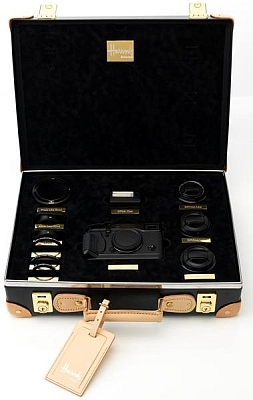
Does this camera case make my butt look big?


Globe-Trotter’s 16" Slim Attache ranges from £375 for the Original to £680 for the Orient. The case made for this Fujifilm X-Pro1 set costs £2569.

This is not the first camera to come in a fancy box. Contax, Leica, Konica, Nikon, Rolleiflex, Hasselblad, and others have done it before. To my knowledge, however, this is the first time the box was meant for travel, i.e., to be seen with in public. I wonder how this attache supplements a fancy camera bag.

Via PhotographyBLOG.

Thursday, March 22, 2012

An Oly by Any Other Name


I have several “first” posts in progress, but this came up and all of my plans went out the window. David Riesenberg, presumably a product designer, made some 3D models of what he’d like to see from Canon’s long awaited mirrorless camera system. It is essentially a flat-top mirrorless camera designed to seamlessly accept an accessory EVF that looks like an SLR prism hump. Personally, I am not a fan of mirrorless cameras with a centrally positioned EVF, and the Leica X1-esque pop-up flash makes me cringe, but I like that he put a combined shutter speed/ISO adjustment dial on it. Even though this kind of dial wiggles a bit, unlike plain shutter speed dials, it’s still very elegant. On the other hand, noise is not a big issue on larger sensors these days, so maybe it’s not as useful as it would have been a few years ago.